
October has witnessed turning points in the American Revolution, breakthroughs in education and civil rights, and events that changed the nation.
For Raleigh and Triangle readers, the month also carries meaningful local connections—from the first North Carolina State Fair in Raleigh to the cornerstone of UNC’s Old East building.
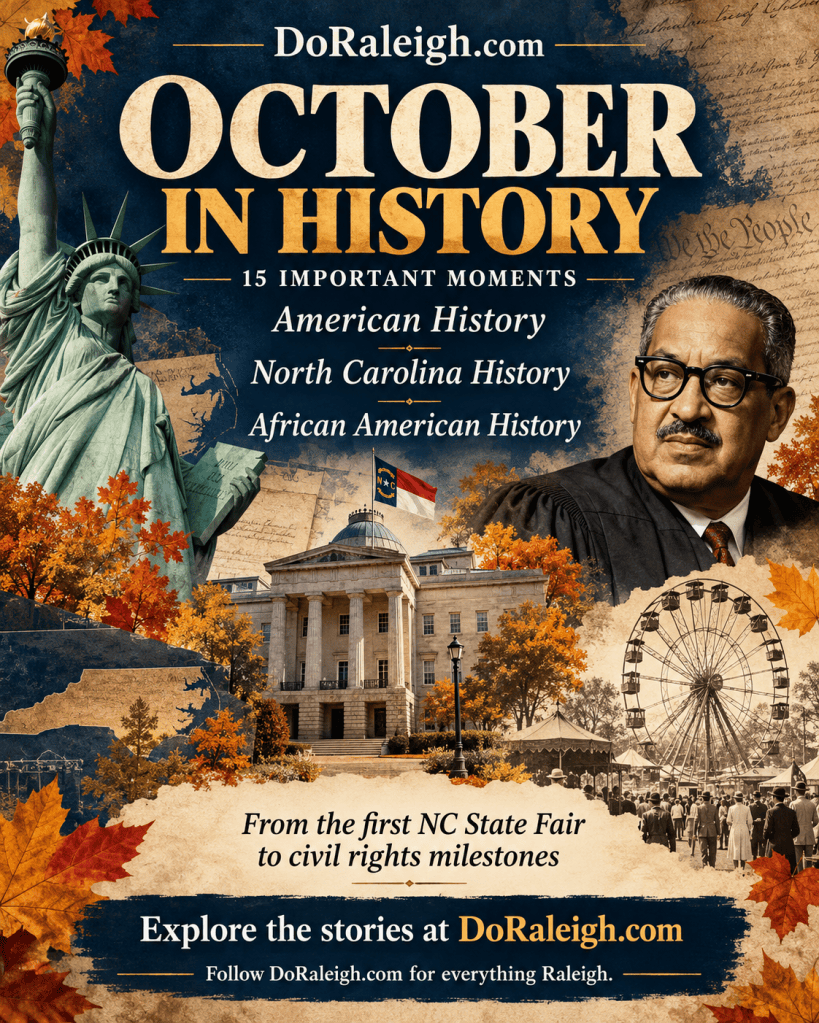
This October history guide highlights 15 important moments across American, North Carolina and African American history. These histories overlap, revealing how local experiences and national movements helped shape the country.
Important October Moments in American History
October 1, 1958: NASA Begins Operations
The National Aeronautics and Space Administration officially began operations on October 1, 1958. The civilian agency absorbed the National Advisory Committee for Aeronautics, beginning a new chapter in American space exploration.
The date marks NASA’s operational beginning; the legislation creating the agency had been signed earlier that year.
October 19, 1781: British Forces Surrender at Yorktown
British forces under General Charles Cornwallis surrendered at Yorktown, Virginia, following a siege by American and French forces.
The victory was a decisive turning point in the Revolutionary War. Although it did not formally end the conflict, it helped pave the way for American independence.
October 22, 1962: Kennedy Addresses the Nation About the Cuban Missile Crisis
President John F. Kennedy publicly announced the discovery of Soviet missile sites in Cuba and a naval quarantine intended to prevent additional offensive weapons from reaching the island.
The address brought Americans face to face with one of the Cold War’s most dangerous confrontations.
October 24–29, 1929: The Stock Market Crash
October 24, known as Black Thursday, began a dramatic stretch of stock-market turmoil, followed by further plunges on October 28 and 29.
The crash became a defining symbol of the Great Depression. It was part of a broader economic breakdown rather than the Depression’s sole cause.
October 28, 1886: The Statue of Liberty Is Dedicated
The Statue of Liberty was dedicated in New York Harbor on October 28, 1886. A gift from the people of France, the monument became a lasting symbol of liberty and, over time, immigration and hope.
Its evolving meaning reflects generations of people seeking freedom and opportunity in the United States.
Important October Moments in North Carolina History
October 7, 1780: The Battle of Kings Mountain
Patriot militia defeated British-led Loyalist forces at Kings Mountain, a major turning point in the Revolutionary War’s Southern campaign.
Although the battlefield is in South Carolina, the battle has strong North Carolina connections through the militia leaders and fighters who helped secure the victory.
October 12, 1793: UNC’s Old East Cornerstone Is Laid
William Richardson Davie helped lay the cornerstone of Old East at the University of North Carolina in Chapel Hill.
The ceremony marked an important construction milestone for the university. It was distinct from UNC’s legislative charter in 1789 and the beginning of instruction in 1795.
October 15, 1954: Hurricane Hazel Strikes the Carolina Coast
Hurricane Hazel made landfall near the North Carolina–South Carolina border as a Category 4 hurricane. Powerful winds and a devastating storm surge caused severe coastal damage.
Hazel remains a major reference point in North Carolina hurricane history and a reminder of the destructive power of coastal storms.
October 18, 1853: The First North Carolina State Fair Opens in Raleigh
The first North Carolina State Fair opened in Raleigh on October 18, 1853, sponsored by the State Agricultural Society.
For Raleigh residents, this anniversary connects a familiar autumn tradition to North Carolina’s agricultural heritage and the capital city’s role as a statewide gathering place.
October 25, 1774: The Edenton Tea Party
Fifty-one women in Edenton signed a statement supporting resistance to British policies and a boycott of British imports, including tea and cloth.
Remembered as the Edenton Tea Party, the action represents an important example of women’s organized political participation before the American Revolution. It centered on a boycott declaration rather than an act of tea dumping.
Important October Moments in African American History
October 2, 1967: Thurgood Marshall Takes His Seat on the Supreme Court
Thurgood Marshall joined the Supreme Court’s opening ceremony as its first African American justice on October 2, 1967.
Before joining the Court, Marshall had established himself as a leading civil rights attorney, challenging racial discrimination and helping lead the legal struggle against school segregation.
October 3, 1904: Mary McLeod Bethune Opens Her School
Educator Mary McLeod Bethune opened a school for Black girls in Daytona Beach, Florida, on October 3, 1904. Her work laid the foundation for what became Bethune-Cookman University.
The milestone reflects the determination of Black educators who expanded educational opportunities during segregation.
October 1966: The Black Panther Party Is Founded
Huey P. Newton and Bobby Seale founded the Black Panther Party for Self-Defense in Oakland, California, in October 1966.
The organization became influential in the Black Power movement. Alongside its opposition to police brutality, it developed community programs that included free breakfasts for children, health clinics and educational initiatives.
October 16, 1859: John Brown’s Raid on Harpers Ferry Begins
Abolitionist John Brown and his followers began their raid on the federal armory at Harpers Ferry, then in Virginia and now in West Virginia.
The effort sought to strike against slavery and included Black participants. Although the raid failed, it intensified the national conflict over slavery before the Civil War.
October 16, 1968: Tommie Smith and John Carlos Protest at the Olympics
During the men’s 200-meter medal ceremony at the Mexico City Olympics, American athletes Tommie Smith and John Carlos raised black-gloved fists.
Their demonstration became an enduring image of protest against racial injustice and a defining moment in the relationship between sports and human rights.
Connecting October History to Raleigh
These anniversaries offer starting points for classroom discussions, family conversations and local history research. The State Fair’s beginnings provide a direct Raleigh connection, while UNC’s history links the month to the wider Triangle.
Together, these stories invite readers to consider how education, civic participation and the struggle for freedom have shaped communities across generations.
Follow DoRaleigh.com for daily updates on government meetings, local festivals, and community happenings — your one-stop guide to everything Raleigh!
Connect With Us: Instagram | Facebook | BSky | Linkedin
Share With Us: Post your community News, Events, on our Submissions Page.
Advertise With Us: Interested in Advertising click here.
Published by Bryan Tomlinson
Design, Optimization, and Marketing by BTDesigns.pro



Leave a Reply