

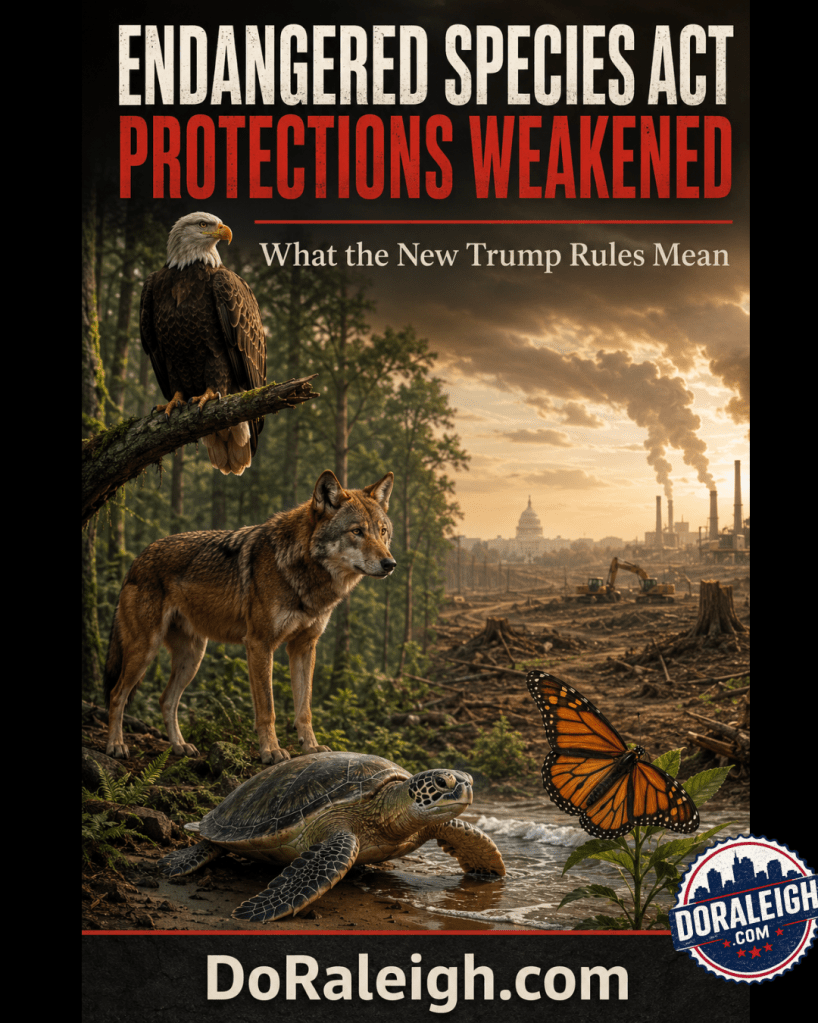
The Trump administration has finalized sweeping regulatory changes that weaken federal protections for animals and plants facing the threat of extinction.
According to reporting published by The Washington Post, the changes narrow how the federal government applies the Endangered Species Act, a landmark conservation law credited with helping save species such as the bald eagle, American alligator and peregrine falcon.
The administration says the revisions will reduce regulatory burdens, provide greater certainty for landowners and businesses, and ensure that environmental protections are balanced against economic concerns. Conservation organizations warn that the rules could accelerate habitat destruction and push vulnerable species closer to extinction.
Threatened species will lose automatic protections
One of the most consequential changes affects wildlife classified as “threatened.”
A threatened species is not yet considered endangered but is likely to become endangered in the foreseeable future. For decades, the U.S. Fish and Wildlife Service generally extended many of the same protections given to endangered species to newly listed threatened species.
Under the administration’s revised approach, threatened species will no longer receive those protections automatically. Federal officials must instead develop a species-specific rule explaining which activities are prohibited.
That process could leave newly listed species without broad safeguards against killing, capturing or other forms of “take” while individualized regulations are being developed.
Supporters argue that species-specific plans provide regulators with greater flexibility. Conservation advocates say the change creates dangerous gaps in protection when vulnerable wildlife may already be declining rapidly.
Habitat destruction will no longer automatically qualify as “harm”
The administration has also rescinded the federal regulatory definition of “harm” under the Endangered Species Act.
Since 1981, the Fish and Wildlife Service’s definition included certain forms of significant habitat destruction that actually killed or injured protected wildlife by interfering with essential behaviors such as breeding, feeding or sheltering.
The new rule removes that regulatory definition. Federal officials argue that the previous interpretation expanded the law beyond its intended meaning and created confusion for property owners, farmers, energy companies and developers.
Environmental groups contend that the distinction between killing wildlife and destroying the habitat wildlife needs to survive is unrealistic. Logging, mining, drilling, road construction and real estate development can eliminate nesting areas, food sources and migration routes even when animals are not killed directly at the project site.
The rule does not remove every federal protection for designated critical habitat. However, it could make it more difficult to prosecute or stop some private activities based on indirect injuries caused by habitat destruction.
Economic costs could influence habitat decisions
The revised regulations also direct the U.S. Fish and Wildlife Service to give greater consideration to the economic, national-security and other consequences of protecting critical habitat.
Critical habitat consists of areas considered essential to the survival and recovery of a protected species. Designations can affect federally authorized or funded projects, including energy development, transportation construction and other land-use activities.
The Endangered Species Act already permits agencies to consider economic effects when deciding whether to exclude particular areas from a critical-habitat designation. The administration’s revisions establish a more formal framework for weighing those costs.
Business and industry groups have long argued that habitat restrictions can delay construction, increase costs and limit the use of private and public land. Conservationists worry that giving economic costs more weight could result in smaller protected areas, even when scientists determine that the habitat is important for preventing extinction.
The administration’s argument
Interior Secretary Doug Burgum and other administration officials say the changes restore the Endangered Species Act to its original purpose.
The Interior Department says narrowing the definition of harm will reduce unnecessary permitting, cut compliance expenses and provide clearer rules for landowners, farmers, ranchers, energy producers, small businesses and local governments.
Administration officials maintain that endangered wildlife will still receive protection and that threatened species can be covered through individualized conservation rules.
Conservation groups promise legal challenges
Environmental organizations strongly oppose the regulatory rollback and are expected to challenge the changes in federal court.
Nine conservation groups have already filed a lawsuit over the administration’s decision to rescind the definition of harm. The organizations argue that the rule contradicts the Endangered Species Act and a 1995 U.S. Supreme Court decision that upheld the government’s authority to treat some habitat destruction as harm to protected wildlife.
Opponents also argue that habitat loss is one of the leading causes of species decline. They say excluding it from the regulatory definition could undermine decades of conservation work.
The legal disputes will likely determine how extensively federal agencies can enforce the new rules.
What could this mean for North Carolina?
North Carolina is home to federally protected wildlife and plants, including red wolves, sea turtles, freshwater mussels, woodpeckers and several rare coastal and mountain species.
Changes to federal habitat and threatened-species protections could affect decisions involving highways, housing developments, utility projects, forestry, coastal construction and energy infrastructure across the state.
The effects will depend on each species’ federal classification, whether critical habitat has been designated and what species-specific rules remain in place. Existing protections will not necessarily disappear immediately, but future listings and habitat decisions could be handled under the administration’s narrower standards.
The bigger picture
The Endangered Species Act was enacted in 1973 to prevent plants and animals from disappearing and to support the recovery of declining species.
The Trump administration describes its revisions as a necessary correction to decades of regulatory expansion. Environmental advocates describe them as one of the most significant rollbacks of American wildlife protections in years.
Regardless of how the administration characterizes the rules, they represent a major change in how the federal government balances species conservation, private property rights and economic development.
Legal challenges, implementation decisions and future species-specific regulations will determine the full impact.
This article summarizes reporting from The Washington Post and information published by the U.S. Fish and Wildlife Service and Federal Register.
Follow DoRaleigh.com for news, government updates and issues affecting Raleigh and North Carolina.
Connect With Us: Instagram | Facebook | BSky | Linkedin
Share With Us: Post your community News, Events, on our Submissions Page.
Advertise With Us: Interested in Advertising click here.
Published by Bryan Tomlinson | BTDesigns.pro |
Sources: The Washington Post, Federal Register final rule, U.S. Fish and Wildlife Service





You must be logged in to post a comment.